N4_
This is taking longer than expected...
Growing up, I was fortunate to have the opportunity to travel a lot thanks to the jobs of my parents.
This instilled in me a love for traveling, discovering new cultures, and the travel industry in general.
One major benefit of traveling with my parents on business, was that we were usually able to travel in Business. I came to appreciate the associated benefits, most notably the comfort of airport lounges.
Later, as a student, I wanted to continue traveling, and, if feasible, do so in comfort.
However, my budget was tight, and so I had to find new creative ways to my voyages.
Hence, I learned more about how airlines and hotels operations, and how to take advantage of the system to one's favour, thanks to resources such as FlyerTalk.
This is also when I learned more about loyalty programs, started to reverse engineer the airline's revenue management, and understand how to use that knowledge to optimise both price and comfort for my own travel planning.
Today I have had the incredible luxury of traveling to many places, and in a classes I wouldn't even have dared to dream of as a child.
Furthermore, I have held frequent traveler stati, that too seemed completely unachievable for my travels and budget.
Today I plan and optimise travel, as well as loyalty for a select few.
All of this I learned thanks to experience and the combined knowledge of the hive-mind that is FlyerTalk.
I would like to continue the cycle of information being passed on for free.
While it is hard to pass on years of experience doing this, I have done my best to write down a basic guide, which you can find below.
Your mileage may vary. Caveats. What is the goal? Give an introduction to some rather complex topics such as the airline landscape, how airline ticketing systems work, how revenue management works, how airlines cooperate, how loyalty programs work, and then based on that knowledge how to use this to optimise your travel, in two senses: Cost of individual tickets and benefits.
| Airline: | SWISS | Scandinavian Airlines | Singapore Airlines | British Airways | Lufthansa |
| IATA: | LX | SK | SQ | BA | LH |
| ICAO: | SWR | SAS | SIA | BA | DLH |
| Airport: | Zurich | Copenhagen | Boston | London Heathrow |
| IATA: | ZRH | CPH | BOS | LHR |
| ICAO: | LSZH | EKCH | KBOS | EGLL |
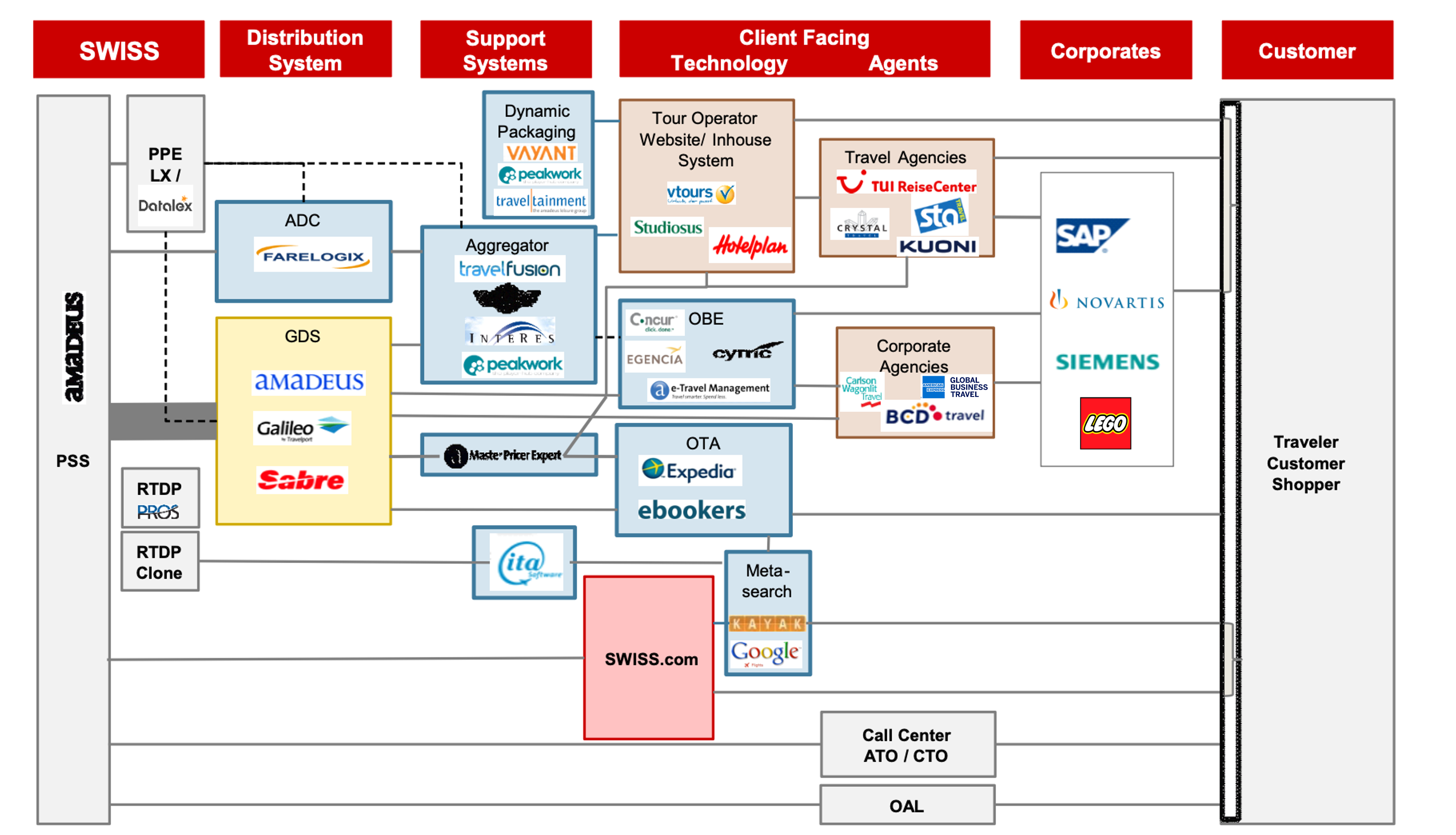
Most airline systems are tightly interconnected. Both in terms operations, given the many different entities that are involved in modern air travel, but also in terms of ticket distribution and sales. Essentially, the airlines make their schedules, availability and fares, as well as ways to book tickets, public via a global distribution system (GDS). There are three main programs that airlines use for this: Amadeus, Galileo and Sabre. The reason for such a global distribution system is this is that airlines want their flight information, availability and fares to be as accessible as possible, so that third parties (such as travel agents, websites etc.) can easily find and book their flights. This system was developed over time, and grew historically, and with how the industry and user behaviour has shifted over time, the result is now quite complicated, as seen in the image on the right. The way of how flights are booked as changed drastically, and nowadays most tickets are sold either directly by the airline on their website, or via traditional travel agents (mostly corporate travel agents) and OTAs (Online Travel Agencies). The whole system in which all this information (schedules, availability and fares) is shared, including the GDS, is often referred to as the matrix. Displayed on the right-hand side are the distribution channels used by SWISS. The underlying system used is Amadeus, but the complicated diagram reflects the various different and oftentimes complicated ways on how information is made available, and how tickets are booked. A lot of this has historically grown, the main goal being to make information about available flights, and more important, purchasing those flights as easy as possible.
Popping the hood on the matrix, the table shown below is a small excerpt of results for an inquiry of flights between ZRH and NYC (which includes all New York airport such as EWR, JFK and LGA), exclusively on flights with a SWISS (LX) flight number. The results includes three direct flights operated by SWISS, as well as one code-share flight operated by United Airlines (UA). Codeshare, as the name implies, is when airlines share their codes to put on flights not operated by themselves. While a flight only ever has one flight number with which it operates, it can be sold under a multitude of codeshare flight numbers. As an example, this flight LX1234 has 5(!) code share flight numbers, each with different availability. In addition to the direct flights, there are many more options with connecting flights. The reason for this is that SWISS is part of the Star Alliance transatlantic Joint Venture (JV), which includes the Lufthansa Group (Austrian, Brussels, Lufthansa, SWISS), United Airlines and Air Canada. These arilines work very closely together, and extensive code-shares are just a part of the JV cooperation. Operating equipment, arrival & destination location and time, frequency and availability in booking classes. But what the hell are booking classes? But what are these weird numbers on the very right? These are the booking classes and the associated availability. Given that the system has historically grown, only one number denotes availability.The numbers go from 0-9. This doesn't mean that there are only a maximum of nine seats per letter, but rather 9 simply indicates that at least nine seats are available.
Shwon above are the results (First Class at the top and Business Class at the bottom). As you can see, there are more fares than booking classes, however, the availability of each fare is dictated by its fare rules, such as advance purchase (AP), it being one-way (OW), round-trip (RT), specific dates or day of the week, as well as the length of stay. And, each fare books into a specific booking class, so for the fare to be available, in addition to the fare rules, the booking class needs to be available.
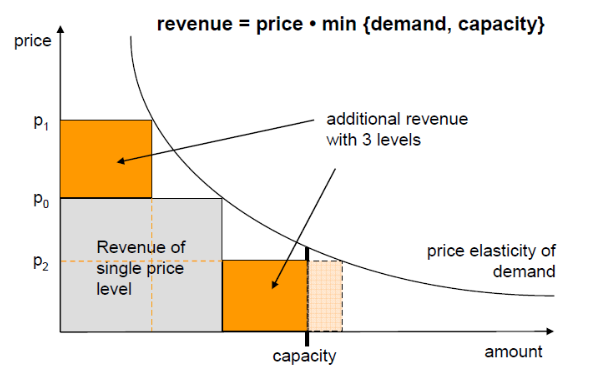
Booking classes, historically, where a way for the airlines to segment the market and to get the customer to pay the maximum that the customer was willing to pay. So in addition to simple suppl and demand (the curve on the right reflects the demand for different ticket prices) and using one price, with the profit reflected by the area of the rectangle drawn from this point, the airlines try to maximize their profits through revenue management, and trying to get each customer to pay the maximum that they are willing to pay. However, since that maximum is not the same for everybody, the airlines are trying to find ways to segment their customers and set the prices based on various different attributes with which they can discriminate their customer base. These factors are included in the fare rules, and result in the different fares and price points for tickets. Factors include, but are not limited to Product (Economy, Premium Economy, Business, First), Route (Direct Flight vs. Flights with connections), origin, destination, type (OW vs RT), felxibility (Refundable vs non-refundable), Dates (specific dates, Thanks Giving, Christmas), weekday (Week-End vs. Week-Days, Duration (Short vs. Long and over the Week-End), Advance Purchase (How far in advance the ticket is bought), sales channel (where the ticket is bought (TA, OTA, CTA etc.), etc. A lot of it essentially comes down to Business vs. Leisure Travellers. In addition, a system checks the forcasted demand, estimated willingness to pay etc. and steers the availability of booking classes (which indirectly affect the available prices)
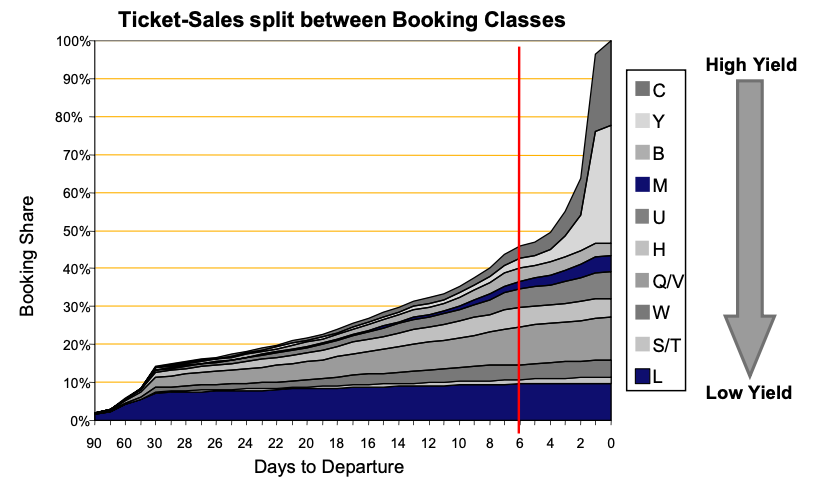
We have stablished ABC, now it is time to take a closer look at a fare, shown below, including the allowed routing table.
Routing Logic, What flights may a fare be booked on? Based on the many airline agreements, codeshare, intelrining, selling connections etc. this tells you Example of Airline A who flies out of, so they codeshare with airline B, to allow access to more destinations, having an agreement to share the revenevue or buying seats at a fixed price. Example of the above routing being allowed.
The Airline Landscape, and all sorts of coop, from codeshare, interlining, to joint ventures to airline alliances.



























































Text
Text about the stuff
Text about the stuff
Show Schedule: (Flight number, origin, destination, times (arr & dep) equipment, booking class availability. What is a booking class? Fares: Fare Basis, Price (OW,RT) Fare Rules (Days, AP, Min, Max, eligibility etc.) Encoded Information: - Fare Basis - Price (OW / RT) - Fare Rules (Days, AP, Min, Max, Change Fees, Cancellation Fees, Routing Options, Flight Eligibility etc.) Public fares, there are also private negotiated fares.
Basic text
All my tips for booking and getting cheap flights, find listed fares, and then find dates that fit criteria with availability. Reposition for cheaper fares / offers etc.
Basic text, give tips on how to optimise travels, treat staff well, give it a try at check-in. Asking usually doesn't hurt, unless your request is very silly. Give examples. Strategically mentioning things and going to talk to people. Usually people are willing and trying to help you out. Example: last minute rebooking and I got put in the worst seat on the plane. Use expertflyer and airline check in system to check seat map and any available flights. No joy. At check-in go to the agents and talk to them, if there are any seats available, mention that you saw it was overbooked, op up hint hint. While in this case i did not get the op up, the person that was left behind one of the best seats in Business into which I was then moved. This is not standard procedure and simply because I had talked to the agent did she shuffle things around in my favour. Very nice. DO care, but not too much, so when things don't work out, you shoul not be disappointed. Don't forget to actually enjoy the experience. When trying to optimise every aspect of travel, especially during traveling, it is easy to forget to enjoy the little things. Give examples.
More strategic, instead of focusing only on one journey and finding the optimal price, optimise travel to be focused on one airline / alliance and maximise status and benefits that way. While it may be cheaper to always book the cheapest option, depending on your travel pattern, this will usually prevent you from significantly accumulating miles or points, which would let you achieve a higher status with this airline and alliance. Hence by focusing your flights on an alliance, and optimise the routings you book, you may be able to achieve status, with which you get benefits, such as lounge access. Overview of the three alliances, regions and status levels and how does alliance relate to airline and vice versa. Generally you are only able to earn with one loyalty program
Mental, Societal, and Environmental
Let us clarify the terms!